Claustrophobia is one of the most common reasons patients delay, reschedule, or cancel a medically necessary MRI. This article outlines the real options available to claustrophobic patients — including solutions most healthcare content never mentions — so that fear of the machine does not prevent access to an important diagnostic tool.
Key Takeaways
✓ Claustrophobia and general MRI anxiety are related but different — the solutions for each are not identical.
✓ Wide-bore MRI machines, like the MAGNETOM Altea used at Lumina, offer significantly more space than traditional scanners.
✓ For many body parts, the scan can be done feet-first — meaning your head never enters the machine at all.
✓ Lumina’s scan rooms include natural light windows, ceiling murals, and music through headphones — features designed to reduce anxiety from the moment you walk in.
✓ Your technologist remains in contact with you throughout the entire scan, and you can pause or stop at any time.
✓ For some clinical questions, a CT scan may be a viable alternative — speak with your referring provider.
✓ Claustrophobia is common. Lumina’s team is experienced in supporting patients through it. Call before you cancel.
You’ve just been told you need an MRI.
For most people, the first thought isn’t about what the results might show. It’s about the machine itself — that narrow tube, the enclosed space, the stillness you’ll be required to hold for what feels like a very long time. And if you live with claustrophobia, that thought can feel like a wall between you and the care you need.
You are not alone in this. Claustrophobia is one of the most frequently cited reasons patients cancel or avoid MRI appointments — sometimes repeatedly, sometimes indefinitely. And when a scan gets cancelled, the health question it was meant to answer goes unanswered, too.
What most patients don’t know — and what most healthcare content doesn’t tell them — is that there are far more options available than simply “push through it” or “ask for a sedative.” Some of those options are straightforward, practical, and available right now at a facility near you.
This article is written for the person sitting with that appointment card and dreading what comes next. There are real solutions. Here’s what they are.
Claustrophobia vs. MRI Anxiety: They’re Not the Same Thing
These two experiences often get grouped together — but they’re distinct, and the distinction matters because the solutions differ.
Claustrophobia is a recognized anxiety condition involving an intense, sometimes overwhelming fear of enclosed or confined spaces. It’s not simply feeling uncomfortable. For people with claustrophobia, being in an enclosed space can trigger a genuine physical stress response — even when there is no objective danger present.
MRI anxiety is broader. Many patients who are not claustrophobic still feel anxious before or during a scan. The noise can be startling. The stillness requirement feels unnatural. The unknown is unsettling. This is situational stress, and it’s completely normal.
Both are valid. Both are manageable. And knowing which one you’re dealing with — or whether it’s some combination — helps you and your care team choose the right approach before your appointment.
Studies suggest that somewhere between one in ten and one in seven patients report significant discomfort during an MRI. In many cases, that discomfort leads to incomplete scans — which means the images can’t be used, and the appointment has to be rescheduled.
What Actually Triggers Claustrophobia in an MRI — And Why Modern Machines Are Different
Understanding what specifically triggers claustrophobia inside an MRI helps explain why newer machine designs are so effective at reducing it.
A traditional MRI bore — the cylindrical opening patients lie inside — is approximately 60 cm or 2 feet in diameter. The machine surface sits just a few inches from a patient’s face. The tube is enclosed on all sides. The patient is required to remain completely still, often for 20 to 45 minutes. Combined with the machine’s loud, rhythmic sounds, it is a sensory environment that can feel genuinely overwhelming for a claustrophobic patient.
Modern wide-bore MRI machines were engineered specifically to address these triggers.
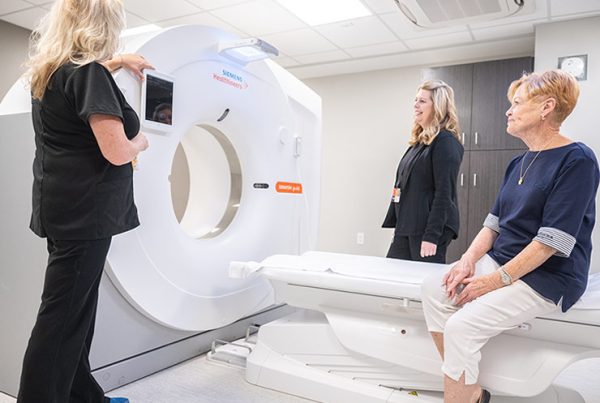
At Lumina Imaging, we use a wide-bore MRI system that provides meaningfully more space between the patient and the machine walls than traditional scanners. The bore is approximately 12% wider. The machine is shorter. Patients can often see outside the bore while they are inside it — a psychological difference that is difficult to overstate for someone who fears enclosed spaces.
You may also have heard of open MRI machines, which remove the tube design entirely. These do exist, but they come with a significant tradeoff: open MRI systems generally operate at a lower magnetic field strength, which means lower image quality. For many diagnostic questions, that difference matters. A wide-bore machine gives you substantially more space than a traditional scanner while still producing the high-resolution images your doctor needs. For most claustrophobic patients, it’s the best of both options.
But the machine is only part of the experience. What surrounds the machine matters just as much.
Lumina’s scan rooms are designed with patient comfort built into the physical space. Natural light windows and ceiling murals create a calming visual environment from the moment you walk in. Headphones with music are provided during every scan. The experience doesn’t start when the scan starts — it starts at the door.
This is a meaningful difference from a hospital radiology department, where the imaging suite is one room among dozens, the environment is clinical, and the ambient stress of a hospital compounds whatever anxiety you already carry.
The Option Most People Don’t Know About: Feet-First Scanning
For many body parts, an MRI can be performed with the patient going into the machine feet-first — meaning your head and upper body remain completely outside the machine throughout the entire scan.
If your head never enters the bore, the fear of being enclosed is essentially eliminated.
This is the most underreported solution in claustrophobia MRI content, and it should be the first question you ask when you book your appointment.
Feet-first positioning is possible for a wide range of common scans, including:
- Knee MRI
- Ankle and foot MRI
- Lower leg MRI
- Hip MRI (in many cases)
- Abdominal and pelvic MRI (in some cases, depending on body type and machine)
It is not possible for all scans — brain, spine, shoulder, and chest MRIs typically require the upper body to be inside the machine. But if you don’t know whether your specific scan can be done feet-first, ask. It’s a simple question that could completely change your experience.
When you call to schedule at any of Lumina’s four Northeast Ohio locations — Medina, Mentor, Solon, and Westlake — ask specifically: “Can my scan be done feet-first?” Our scheduling team can answer that question directly or connect you with a technologist who can.
Before Your Scan: How to Prepare in a Way That Actually Helps
Tell the scheduling team before you book.
This is the most important step, and many patients skip it out of embarrassment or because they assume it won’t make a difference. It does.
When you call Lumina to schedule, let the team know you experience claustrophobia. That simple disclosure allows the scheduling team to flag your appointment, allocate extra preparation time, connect you with a technologist who can walk you through what to expect, and discuss whether feet-first positioning is possible for your scan.
Lumina works to schedule patients for their scan as quickly as possible. This means you don’t have to sit with the dread of a scan that’s a month away. That waiting period is often where anxiety compounds the most.
Have a conversation with your own doctor.
If your claustrophobia is significant, it’s worth a brief conversation with your prescribing physician — not the imaging center — about whether a short-acting anti-anxiety medication before the scan might be appropriate for you.
This is a legitimate, commonly used option. Many patients complete MRIs comfortably with the support of a low-dose medication taken beforehand. If you do go this route, you will need someone to drive you to and from your appointment.
This is a conversation to have with your own doctor, who knows your full medical history. Lumina’s team can note that you’ve discussed this with your provider, but medication decisions are made by your physician — not the imaging center.
Prepare your senses before the day.
- Listen to MRI sounds beforehand. Search online for recordings of MRI machine sounds. Hearing them in a comfortable setting — at home, with no pressure — strips away the startle response on scan day.
- Practice a brief breath hold. Technologists sometimes ask for a short breath hold during certain sequences. Practice holding your breath for 15 to 20 seconds at home. Knowing you can do it removes one unknown from the experience.
- Choose your music in advance. Lumina provides headphones and music during your scan. Coming in with a playlist already in mind gives you something to focus on other than the machine.
During Your Scan: What Lumina Does Differently
You are never alone.
Your technologist is in active communication with you throughout the entire scan. They can see you, hear you, and speak with you at any point. There is always a call mechanism within reach. If you need to pause, stop, or simply hear a reassuring voice, your technologist is there. The scan does not continue without your comfort and consent.
This matters because one of the central fears of claustrophobia is the sense of being trapped with no way out. In a Lumina scan, there is always a way out, and your technologist will make sure you know that before the scan begins.
The noise is manageable.
MRI machines are loud. The banging and knocking sounds are caused by the rapid switching of electrical currents in the gradient coils — completely normal and harmless, but startling if you’re not expecting it. The headphones with music significantly reduce the perceived volume while giving you something pleasant to focus on. And if you’ve listened to MRI recordings at home beforehand, the sounds will already feel familiar.
No hospital environment.
Lumina operates outside of the traditional hospital setting by design. There is no emergency department noise filtering through the walls, no long impersonal intake process, no clinical ward atmosphere. Each of Lumina’s four locations is a dedicated imaging center staffed by experienced radiologic technologists whose entire focus is the imaging experience.
When MRI Isn’t the Only Option: Is a CT Scan Right for You?
This is an honest conversation most imaging content avoids.
MRI is the preferred imaging tool for many conditions — particularly soft tissue injuries, neurological concerns, joint problems, and anything involving the brain or spine. For these applications, an MRI provides information that a CT scan simply cannot replicate.
But for some diagnostic questions, a CT scan may provide sufficient information. CT scans are faster — the actual scan time is typically under a minute — and the machine design is considerably less enclosed than an MRI bore. Many patients who cannot complete an MRI tolerate a CT scan without significant difficulty.
This is not a decision to make on your own. It requires a conversation with the doctor who ordered your imaging about whether the clinical question can be answered by a CT or whether an MRI is specifically necessary.
At Lumina, both MRI and CT scans are available at all four locations. If you and your provider determine that a CT is appropriate, Lumina can coordinate that quickly — often with same-day or next-day availability.
You Have More Options Than You Think
Claustrophobia is common and manageable. Before you cancel your scan, know this: there may be a straightforward solution you haven’t been told about yet.
Ask whether your scan can be done feet-first. For many body parts, your head never enters the machine. Choose a wide-bore MRI facility. The difference in space is significant. Tell the scheduling team about your claustrophobia so they can prepare. Talk to your doctor about whether a short-acting medication or an alternative scan type might be right for you.
Lumina’s technologists have supported many patients through this — patients who arrived anxious and left with their scan completed and their questions answered.
Ready to talk through your options? Contact Lumina Imaging or call us at 440-592-6060.